

BLENDING: SEE THE SCIENCE OF HAE

HAE swelling attacks begin with an internal chain reaction. Approved treatments target different parts of the reaction, but may require repeated lifelong dosing to continuously maintain control of the chain reaction and manage attacks.1
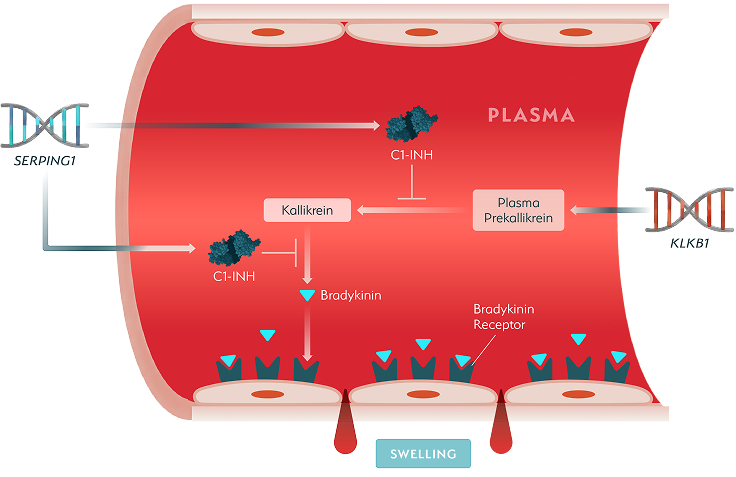
What Causes HAE?
Typically, a protein called C1-inibitor (C1-INH) helps control swelling. The instructions for making C1-INH come from the SERPING1 gene. People living with HAE Type I or Type II have changes in this gene. Their bodies can’t make enough C1-INH, or the C1-INH doesn’t work properly. As a result, a substance called bradykinin builds up and causes swelling.2,3
How Do HAE Swelling Attacks Happen?
HAE attacks happen when too much bradykinin builds up in the blood vessels, causing fluid to leak into nearby tissues. Bradykinin is produced after factors in your body activate a protein called plasma prekallikrein, which is made using instructions from the KLKB1 gene.2,3
What Is a Gene?
Genes provide the body with instructions to make proteins and control different functions.4
What Is a Protein?
Proteins are made by your body to do specific jobs.5
Get to Know HAE at a Deeper Level
Advocacy & Support
Stay Informed
References:
- Maurer M, Magerl M, Betschel S, et al. The international WAO/EAACI guideline for the management of hereditary angioedema-the 2021 revision and update. Allergy. 2022; 77(7):1961-1990. doi:10.1111/all.15214
- Wedner HJ. Hereditary angioedema: pathophysiology (HAE type 1, HAE type II, and HAE nCI-INH). Allergy Asthma Proc. 2020;41(Suppl 1):S14-S17. doi:10.2500/aap.2020.41.200081
- De Maat S, Hofman ZLM, Maas C. Hereditary angioedema: the plasma contact system out of control. J Thromb Haemost. 2018;16(9):1674-1685. doi:10.1111/jth.14209
- National Human Genome Research Institute. Gene. National Institutes of Health. Updated March 31, 2026. Accessed March 31, 2026. https://www.genome.gov/genetics-glossary/Gene
- National Human Genome Research Institute. Protein. National Institutes of Health. Updated March 31, 2026. Accessed March 31, 2026. https://www.genome.gov/genetics-glossary/Protein
This information is for educational purposes only and is not intended to constitute medical advice. For all healthcare decisions, talk with your healthcare team.